Designing the Future of
ERP and LMS Integration
Why the wall between "Management" and "Learning" is collapsing. Enter the era of Autonomous AI Systems that unify campus operations with student success.
The average educational institution uses 7 different software systems. Each one was purchased to solve a specific problem. Together, they create a bigger problem: data fragmentation.
Your ERP knows who paid their fees. Your LMS knows who completed the course. Your CRM knows who inquired about admission. But none of them talk to each other. The result is that your most important decisions — about student retention, curriculum quality, and operational efficiency — are made with incomplete information.
The future of education technology is not more tools. It's fewer, smarter systems — unified platforms where ERP, LMS, and CRM functions are integrated under a single Autonomous AI layer that can see the complete picture and act on it.
This article explores what this unified future looks like, why it matters, and how institutions can make the transition without disrupting their operations.
The Silo Problem: Why Fragmented Systems Fail Students
Each system in your current stack was designed to be excellent at one thing. The problem is that students don't live in one system — they exist across all of them simultaneously.
| System | What It Stores | What It's Missing |
|---|---|---|
| ERP System | Student enrollment, fees, attendance, HR, timetable | Learning outcomes, engagement data, content performance |
| LMS Platform | Course content, quiz scores, video completions | Fee status, enrollment history, parent contact, HR data |
| CRM Tool | Lead pipeline, admission inquiries, follow-up history | Academic performance, engagement, course completion |
| Communication Tool | Messages sent, email open rates | Context of why a message was sent, student performance at the time |
The hidden cost: Research shows that administrators in fragmented-system environments spend 15-20 hours per week manually transferring data between systems, reconciling discrepancies, and generating reports that require data from multiple sources. This is pure waste.
The Unified Education Operating System: What It Looks Like
A unified Education OS doesn't just connect existing systems — it replaces them with a single, coherent platform where every function is designed to work together from the ground up.
The 4-Layer Architecture of a Unified AI Education Platform
Understanding the architecture helps institutions evaluate whether a platform is truly unified or just a collection of tools with a shared login.
Data Layer
All student, operational, and financial data stored in a unified, normalized database. No silos, no duplicates.
Intelligence Layer
Agentic AI analyzes cross-system data to generate insights, predictions, and recommendations that no single-system AI could produce.
Automation Layer
Trigger-based workflows that span ERP, LMS, and CRM functions — automatically, without manual coordination between departments.
Experience Layer
Unified interfaces for students, faculty, admins, and parents — each seeing a role-appropriate view of the same underlying data.
6 Transformative Benefits of ERP-LMS Integration with AI
When ERP, LMS, and CRM data flows through a single AI layer, entirely new capabilities emerge that are impossible with fragmented systems.
360° Student Profile
Every stakeholder — teacher, counselor, admin, parent — sees a complete picture of the student: academic performance, fee status, attendance, engagement, and communication history in one place.
Automated Workflows Across Systems
When a student's fee is overdue AND their engagement drops, the system automatically triggers a counselor alert, a parent notification, and a retention offer — without any manual coordination.
Unified Reporting
Generate reports that combine academic outcomes with financial data, operational metrics, and engagement signals. No more manual Excel merging across systems.
Predictive Enrollment Planning
Historical data from ERP (enrollment patterns) combined with LMS data (completion rates) enables accurate forecasting of next batch sizes and revenue.
Seamless Student Journey
From first inquiry to course completion to alumni status, the student's entire journey is tracked in one system, enabling personalized communication at every stage.
Compliance and Audit Ready
Unified data makes regulatory compliance reporting trivial. All required data is in one place, consistently formatted, and audit-ready.
Automation That Spans the Entire Student Lifecycle
In a unified platform, automation workflows can span functions that were previously in separate systems. A single trigger can initiate actions across what used to be ERP, LMS, and CRM simultaneously.
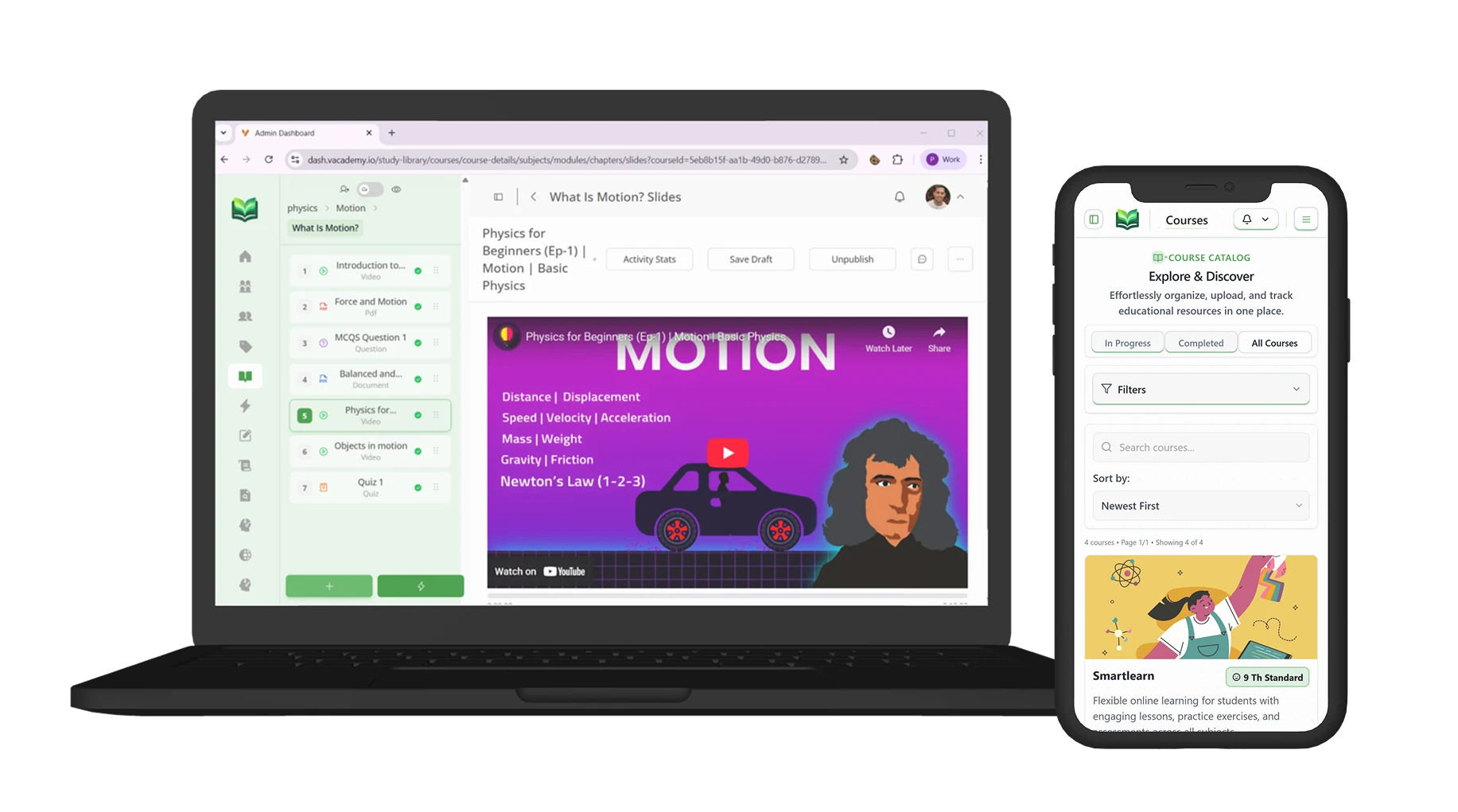
Watch: Unified platform managing content, operations, and student data in one place.
The Migration Roadmap: Moving to a Unified Platform Without Disruption
The biggest concern institutions have about moving to a unified platform is disruption. Here's a proven 6-step migration roadmap that minimizes risk.
Audit Current Systems
Document all existing tools, data flows, and integration points. Identify redundancies and gaps.
Data Migration Planning
Map existing data to the unified schema. Plan migration sequence to minimize disruption.
Parallel Running Period
Run old and new systems simultaneously for 30 days to validate data accuracy and train staff.
Phased Cutover
Migrate department by department — starting with LMS, then CRM, then ERP functions.
AI Training Period
Allow the AI 30-60 days to build behavioral baselines before relying on its predictions.
Full Autonomous Operation
Decommission legacy systems. The unified AI platform operates autonomously with human oversight.
Ready to Unify Your Education Stack?
See how Vacademy replaces your fragmented tools with a single, intelligent Education Operating System.
Frequently Asked Questions
Does Vacademy fully replace our existing ERP system?
Vacademy replaces the student-facing and academic functions of most ERP systems — enrollment management, attendance, timetabling, fee collection, and reporting. For institutions with complex HR or accounting requirements, Vacademy integrates with specialized HR and accounting software via API.
How long does the migration typically take?
For a mid-sized institution (500-5,000 students), the migration typically takes 4-8 weeks. This includes data migration, staff training, and a parallel running period. Larger institutions may require 3-6 months for a phased migration.
What happens to our existing student data during migration?
All existing student data is migrated to Vacademy's unified database. Our migration team handles the data transformation and validation process, ensuring no data is lost. Historical records are preserved and accessible.
Can Vacademy integrate with our existing accounting software?
Yes. Vacademy provides API integrations with popular accounting software including Tally, QuickBooks, and Zoho Books. Fee collection data flows automatically to your accounting system without manual entry.
How does the unified platform handle multiple campuses or branches?
Vacademy supports multi-campus institutions with a hierarchical permission structure. Each campus has its own data space while the central administration has visibility across all campuses. Cross-campus reporting and benchmarking are built in.
What training is provided for staff during the transition?
Vacademy provides comprehensive onboarding including live training sessions, video tutorials, and a dedicated customer success manager for the first 90 days. Most staff are fully proficient within 2 weeks.
Ready to experience the
Future of Learning?
Join thousands of educators and institutions who have switched to Vacademy for a seamless, automated, and intelligent teaching experience.